श्रीमद्भगवद्गीता
Before the battle, a conversation.
Read all 701 verses of the Bhagavad Gita, see how its ideas connect, and bring your own questions to it.

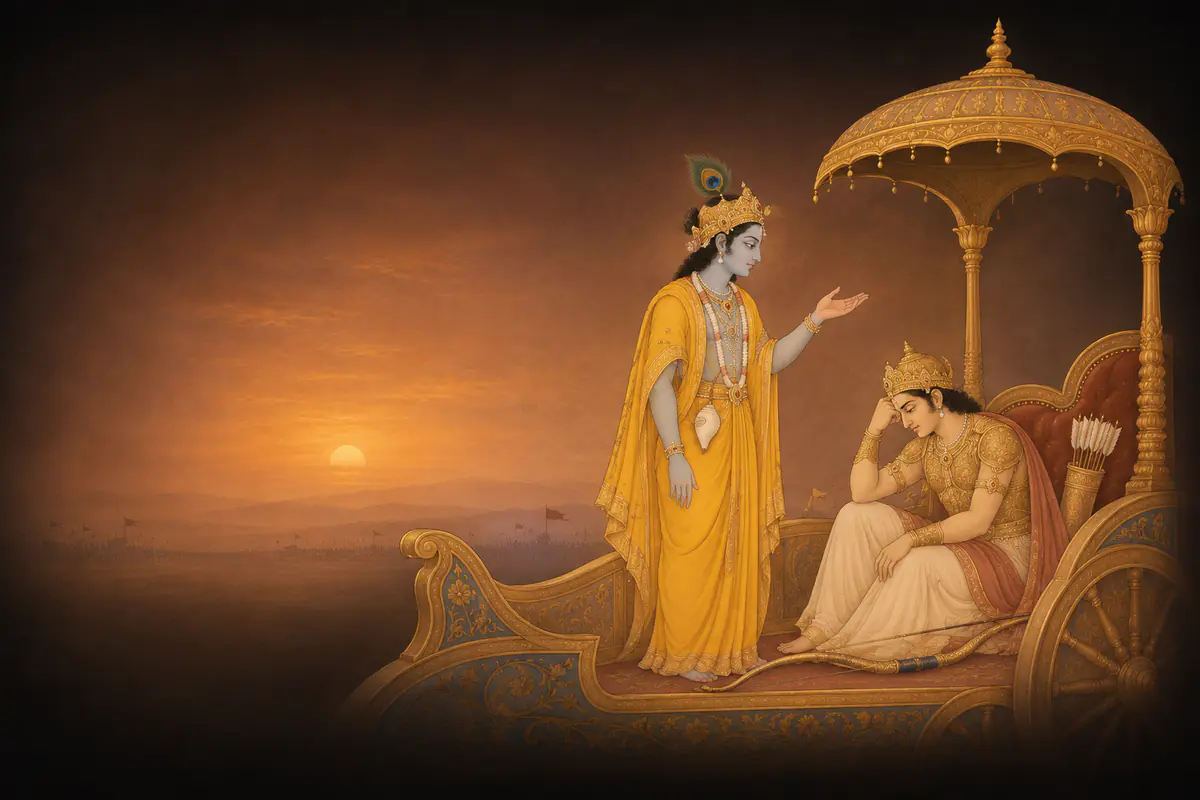
The Gita begins with someone who wants to walk away.
Between two armies, Arjuna puts down his bow and says he will not fight. Krishna's answer to that one frozen moment is the whole Gita.
क्षुद्रं हृदयदौर्बल्यं त्यक्त्वोत्तिष्ठ परन्तप ॥
“Shake off this base faint-heartedness and arise, O conqueror of foes!”
What are you facing?
Each opens the verses that speak to it.
The verse most people know
कर्मण्येवाधिकारस्ते मा फलेषु कदाचन ।मा कर्मफलहेतुर्भूर्मा ते सङ्गोऽस्त्वकर्मणि ॥
karmaṇyevādhikāraste mā phaleṣu kadācana |mā karmaphalaheturbhūrmā te saṅgo’stvakarmaṇi ||
“You have the right to work alone, but not to the fruits of it. Do not be driven by the results of your work, nor have attachment to inaction.”
In short: Give the work everything. Let go of what it earns you.
In chapter 11, Arjuna asks to see everything at once.
Explore does that for the text itself: every verse, idea, state of mind and life situation on one map, with the threads between them.

What is on the map
- Chapters
- 18
- Verses
- 701
- Sanskrit ideas
- 67
- States of mind
- 33
- Life situations
- 22
- Characters
- 16
5,350 connections between them: which verse defines an idea, which state heals another, which verses answer which questions.
Point at the map, or tap on a phone. Drag sideways to turn it.
Eighteen chapters, from doubt to resolve.
Read it in order, with the Sanskrit, transliteration, several translations, classical commentaries and recitation for every verse.
All eighteen
Pick any chapter. Read remembers where you stopped.
Come in however suits you.
Your first five minutes
A short lesson on 2.47: the setting, the verse, what it means in plain words, and an example from everyday life.

Write what is on your mind
Reflect suggests the states, situations and verses your words touch. You keep the ones that fit. Everything stays in this browser.
Follow one thing to the next
Verses 2.62 and 2.63 trace how brooding becomes ruin. Lineage lays chains like this out step by step.
- Dwelling on things
- Attachment
- Desire
- Anger
- Delusion
- Lost memory
- Lost judgement
- Ruin
Ask the text
Answers are built from the verses and show which ones they draw on.
Free to use, private by default.
Your thoughts stay with you
Reflections are saved on this device, in this browser. They don't sync anywhere; export them when you want to move them.
AI is optional
Reading, search, the graph and suggestions all work without a language model. If you connect one, only the text you choose is sent.
Built on open texts
Sanskrit, translations and commentaries come from open datasets, chiefly the Gita Initiative's gita/gita. Recitations stream from holy-bhagavad-gita.org.